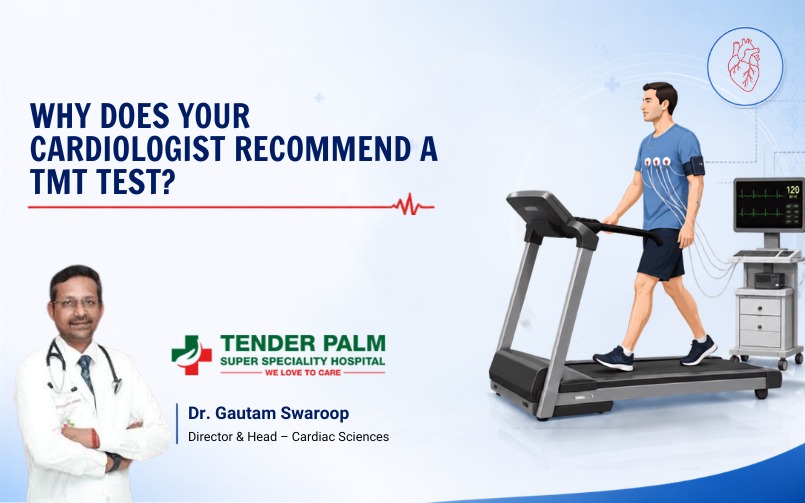
Why Does Your Cardiologist Recommend a TMT Test?
Quick Answer
A TMT test, also called a Treadmill Test or Exercise Stress Test, is a heart test that checks how your heart responds when your body is working harder than usual. During the test, you walk on a treadmill while your ECG, heart rate, blood pressure, and symptoms are monitored closely.
Cardiologists often recommend this test when they want to understand chest pain, breathlessness, palpitations, reduced exercise tolerance, or a possible lack of blood flow to the heart.
A TMT test is useful because some heart problems do not show up clearly when you are resting. The test creates controlled physical stress so the doctor can see how the heart behaves under load. A normal result can be reassuring, but it does not automatically mean every heart problem has been ruled out. An abnormal or inconclusive result does not mean panic either. It simply means your cardiologist may need more information before deciding the next step.
Introduction
Many people feel nervous the moment they hear the words “treadmill test.” That reaction is normal. Anything related to the heart sounds serious, and it should be taken seriously. But seriousness does not mean danger or panic. In most cases, a TMT is a routine, carefully supervised test that helps doctors understand what is happening inside the heart in a practical, real-world way.
The heart is not just a machine that works at rest. It has to perform under stress, during movement, and during daily activity. A person may feel perfectly fine while sitting, but develop chest discomfort, shortness of breath, dizziness, or unusual fatigue while walking fast, climbing stairs, or exercising. That is exactly where a treadmill test becomes useful.
A TMT test evaluates how the heart performs during exercise. It helps detect signs that the heart may not be getting enough oxygen-rich blood when demand increases. It can also reveal whether symptoms such as chest pain or breathlessness are linked to the heart or may be due to another cause.
For many patients, the test is not just about finding disease. It is also about finding reassurance, assessing risk, and choosing the right next step. A well-interpreted TMT can prevent both overreaction and underdiagnosis. That is why it remains one of the most practical tests in cardiology.
Table of Contents
- What is a TMT test?
- Why do cardiologists recommend it?
- How is the TMT test done?
- Is the test safe?
- Myths vs. facts about TMT
- What do TMT results mean?
- What happens after the test?
- When should symptoms not be ignored?
- Frequently asked questions
What Is a TMT Test?
TMT stands for Treadmill Test. It is also called an exercise stress test because it checks how the heart performs when the body is under physical stress.
The idea behind the test is simple. When you exercise, your muscles need more oxygen. To supply that oxygen, the heart must pump more blood, faster and more efficiently. If the heart’s blood supply is limited, signs of that problem may appear during exercise even when everything looks normal at rest.
During the test, electrodes are attached to your chest to record the ECG. A nurse or technician monitors your symptoms and the machine records your heart rhythm. You walk on a treadmill that slowly becomes faster and steeper in stages. The test is designed to gradually increase the workload on your heart in a controlled way.
This controlled stress can help the cardiologist see:
- whether the heart rhythm stays stable
- whether blood pressure responds normally
- whether chest discomfort appears with exertion
- whether the ECG shows signs of reduced blood flow
- how much exercise you can safely tolerate
A TMT test is not the same as a resting ECG. A resting ECG is done while you are sitting or lying down. A TMT shows the heart under load. That difference matters because some abnormalities show only when the heart is pushed harder.
Why Does a Cardiologist Recommend a TMT Test?
A cardiologist does not recommend a TMT without a reason. It is usually ordered because the doctor wants a clearer answer than a resting check-up can provide.
1. Chest pain or chest discomfort
One of the most common reasons for a TMT is chest pain evaluation. Chest pain does not always come from the heart, but it cannot be ignored. If pain appears during walking, climbing stairs, or exertion, the doctor may want to see whether the heart is receiving enough blood under stress.
2. Breathlessness on exertion
Some people get short of breath much earlier than expected. They may struggle with stairs, brisk walking, or routine physical activity. A treadmill test helps the cardiologist check whether the heart is part of the problem.
3. Palpitations or skipped beats
If the heart races, flutters, or feels irregular during activity, a TMT may help identify whether exercise triggers rhythm changes. Some rhythm problems become more obvious when the heart rate rises.
4. Reduced exercise tolerance
Sometimes the issue is not pain but poor stamina. A person may say, “I cannot do what I used to do,” or “I get tired much faster than before.” A TMT can help evaluate whether that drop in exercise capacity is related to the heart.
5. Risk assessment
People with risk factors such as diabetes, high blood pressure, smoking, obesity, high cholesterol, or a family history of heart disease may need a closer look if they have symptoms. In some cases, the TMT helps decide how worried the doctor should be.
6. Suspected coronary artery disease
If the doctor suspects that the blood supply to the heart may be reduced, the TMT can show whether exercise causes ECG changes or symptoms that fit that pattern.
7. Follow-up after previous heart issues
In some cases, a cardiologist may use a TMT to check exercise capacity or recovery after prior cardiac treatment, depending on the patient’s condition.
The key point is this: a TMT test is not ordered randomly. It is used because the cardiologist wants to connect symptoms, risk factors, and heart function in a meaningful way.
How Is the TMT Test Done?
The test is usually simple, but it is done carefully.
Before the test
You may be asked about:
- current symptoms
- past heart problems
- medicines
- diabetes or blood pressure
- recent food or caffeine intake
- whether you are physically able to walk on a treadmill
Small electrodes are placed on the chest so the ECG can be recorded continuously. Your blood pressure is checked before the test begins.
During the test
You begin walking on the treadmill. The speed and incline increase in stages. The doctor or technician watches for:
- ECG changes
- abnormal heart rate response
- abnormal blood pressure response
- chest pain
- shortness of breath
- dizziness
- unusual fatigue
The point is not to push you to collapse. The point is to see how your heart behaves under increasing workload while staying under medical supervision.
When the test is stopped
The test may be stopped if:
- you reach the target heart rate
- you develop chest pain
- your blood pressure response becomes abnormal
- you feel too breathless or dizzy
- the ECG shows concerning changes
- you become too tired to continue
- the doctor decides enough information has been collected
After the test
You are usually observed for a short period while your heart rate and blood pressure settle back toward normal. Then the cardiologist interprets the findings along with your history and symptoms. Most patients complete the process in less than an hour. The walking part itself is usually much shorter.
Is the TMT Test Safe?
For most people, yes. A TMT test is commonly done and is generally safe when performed in a proper clinical setting.
The important word here is supervised. The test should not be treated casually, but it also should not be feared unnecessarily. The medical team is trained to observe changes early and stop the test if needed.
During the test, you may feel:
- tired
- warm
- sweaty
- slightly breathless
- your heart beating faster
- heaviness in the legs from walking
Those sensations are often expected because the heart is being made to work harder in a controlled way. What matters is whether the symptoms are normal for exertion or whether they appear in a pattern that concerns the cardiologist.
A safe test is not just about the machine. It is about monitoring, timing, judgment, and interpretation. That is why a treadmill test should be done where emergency support is available if needed.
Myths vs. Facts About TMT
| Myth | Fact |
|---|---|
| TMT is only for elderly people. | Younger people may also need it if they have symptoms or risk factors. |
| If my resting ECG is normal, my heart must be fine. | A resting ECG can be normal even when problems appear only during exercise. |
| The treadmill test is dangerous because it stresses the heart. | The test is designed to stress the heart in a controlled, monitored way. That is exactly why it is useful. |
| A normal TMT means I can never have a heart problem. | No single test can rule out every heart problem. A normal TMT is reassuring, but symptoms still matter. |
| A positive TMT always means a major blockage. | Not always. Some abnormal results need more testing before the cause is clear. |
| The written report alone tells the full story. | The report must be interpreted with the symptoms, medicines, age, risk factors, and clinical history. |
| If the test is abnormal, the situation is already severe. | An abnormal result is information, not a final verdict. It helps guide the next step. |
What Do the Results of a TMT Test Mean?
TMT reports can look technical, but the basic meaning is usually straightforward once the cardiologist explains it properly.
1. Normal or negative result
A normal TMT usually means there were no concerning ECG changes or symptoms during exercise. That is reassuring.
It suggests that the heart handled exercise without obvious signs of poor blood supply. In many cases, that lowers the chance that chest symptoms are due to significant coronary artery disease.
But here is the important part: a normal TMT does not guarantee that everything is perfect. Some heart problems are not picked up by this test. Also, if the symptoms remain strong or suspicious, the doctor may still look further.
2. Positive or abnormal result
A positive or abnormal TMT may suggest that the heart muscle was not getting enough blood during exercise. It may also indicate a rhythm problem, abnormal blood pressure response, or another exercise-related issue.
This does not automatically mean a person has a severe blockage. It means the result is suspicious enough that the cardiologist may want another test, such as:
- echocardiography
- stress imaging
- CT coronary angiography
- other cardiac investigations depending on the patient
The word positive on a TMT report should never be interpreted by the patient alone as a final diagnosis. It is a clue, not a conclusion.
3. Inconclusive or equivocal result
Sometimes the test does not give a clear answer. That can happen if:
- the person could not exercise long enough
- the target heart rate was not reached
- the ECG changes were unclear
- the report was affected by medicines
- symptoms were too vague to interpret confidently
An inconclusive result does not mean normal. It means the test did not provide enough evidence in either direction.
4. Why the report must be read by a cardiologist
This part matters more than most people realize. The same type of change may mean different things in different people.
A small ECG change in a young person with no risk factors may be less concerning than the same change in someone with diabetes, smoking history, high blood pressure, or strong family history. A test also cannot be judged in isolation from the story of the patient.
That is why a cardiologist does not read the report line by line and stop there. The report is combined with:
- symptoms
- physical examination
- risk factors
- age and sex
- medicines
- exercise duration
- heart rate achieved
- ECG pattern during and after exercise
In other words, the report is only one piece of the puzzle.
What Happens After the Test?
What happens next depends on the result and on why the test was done in the first place.
If the test is normal
The cardiologist may:
- reassure you
- look for non-cardiac causes of symptoms
- manage risk factors
- advise lifestyle changes
- continue observation if symptoms are mild
If the test is abnormal
The doctor may recommend more testing or treatment depending on the overall picture. Not every abnormal TMT leads to the same next step. The best next action depends on the severity and pattern of findings.
If the test is inconclusive
The cardiologist may repeat the test later, adjust medicines, or choose another type of investigation if needed.
The point is not just to label the result. The point is to decide what the result means for you.
When Should Symptoms Not Be Ignored Even If the Test Is Normal?
This is one of the most important parts of the discussion.
A normal TMT can be reassuring, but it should never be used as an excuse to ignore continuing symptoms. Do not brush off symptoms if you have:
- chest pain that keeps coming back
- chest tightness on exertion
- worsening breathlessness
- palpitations with dizziness
- fainting or near-fainting episodes
- pain that improves with rest and returns with activity
- strong family history of heart disease
- diabetes, smoking history, obesity, or high blood pressure with ongoing symptoms
A person can have a normal test and still need more evaluation if the symptoms are convincing. The body does not always announce disease in a neat and textbook way.
Seek prompt medical attention if chest discomfort becomes severe, breathlessness worsens quickly, or fainting occurs. Those are not symptoms to wait on.
Frequently Asked Questions
- 1. Is the TMT test painful?
- No. The test is not painful. You may feel tired or breathless because of the treadmill walking, but the test itself does not involve needles or surgery.
- 2. Can I eat before a treadmill test?
- That depends on the instructions from your doctor or clinic. Some patients may be advised not to eat heavily right before the test.
- 3. Do I need to stop medicines before the test?
- Not always. Some medicines may affect the result, so your cardiologist will tell you what to continue and what to avoid.
- 4. How long does the test take?
- The total visit is usually under an hour, though the treadmill portion itself is shorter.
- 5. Does a normal TMT mean I am completely safe?
- No. It is reassuring, but it is not a lifetime guarantee. Symptoms and risk factors still matter.
- 6. What should I do if my TMT report is abnormal?
- Do not panic. Show it to a cardiologist so the report can be interpreted correctly and the next step can be decided.
- 7. Is TMT useful for everyone with chest pain?
- Not always. The right test depends on the person, the symptoms, and the overall clinical picture. Your cardiologist decides what is appropriate.
About Dr. Gautam Swaroop
Dr. Gautam Swaroop is a Cardiologist who focuses on helping patients understand heart symptoms, diagnostic tests, and treatment decisions in a clear and practical way. His approach emphasizes timely evaluation, evidence-based care, and patient education.
This article is for general educational purposes only and should not be taken as personal medical advice. A TMT report must always be interpreted along with your symptoms, medical history, examination findings, medicines, and other investigations. If you have chest pain, severe breathlessness, fainting, or persistent palpitations, seek medical care promptly rather than waiting for symptoms to settle on their own.

You must be logged in to post a comment.