What to Expect During Renal Denervation: A Patient’s Step-by-Step Guide
Quick Answer
Renal denervation (RDN) is not for every patient with high blood pressure. It is designed for carefully selected patients whose blood pressure remains uncontrolled despite proper lifestyle changes and appropriate antihypertensive treatment. In simple terms, RDN is a minimally invasive catheter-based procedure that targets the nerves around the renal arteries and is used as an additional treatment, not a replacement for medical care.
Introduction
High blood pressure is one of the most common and most serious long-term health problems in the world. Many people live with hypertension for years without noticing any symptoms, but the damage can slowly continue in the background. Uncontrolled blood pressure can strain the heart, injure the blood vessels, harm kidney function, and increase the risk of stroke, heart attack, and other complications. That is why hypertension is not a condition to ignore or manage casually.
For many patients, lifestyle changes and medicines work well. But there is also a group of patients whose blood pressure remains above target even after they are trying hard, taking treatment regularly, and making the right changes. This is the group in which renal denervation may be considered. The important point is that RDN is not about replacing standard treatment. It is about offering another option for selected patients when standard care alone is not enough.
That is also why patient selection matters more than the procedure itself. If the wrong patient is chosen, the benefit may be limited. If the right patient is chosen after a proper evaluation, the procedure may have a meaningful role in blood pressure control. In this sense, RDN is less about the excitement of a new technique and more about using the right treatment for the right person at the right time.
Dr. Gautam Swaroop helps patients understand whether RDN is appropriate based on their blood pressure pattern, overall health, medical history, and response to treatment. A good decision begins with careful evaluation, not assumptions.
Table of Contents
- What Is Renal Denervation?
- Why Patient Selection Matters
- Who May Be an Ideal Candidate?
- Who May Not Be a Suitable Candidate?
- Tests and Evaluation Before RDN
- Step-by-Step RDN Procedure
- What to Expect on the Day of the Procedure
- Recovery After Renal Denervation
- Benefits and Limitations
- Myths vs Medical Facts
- When to Speak to a Cardiologist
- Frequently Asked Questions
- Conclusion
What Is Renal Denervation?
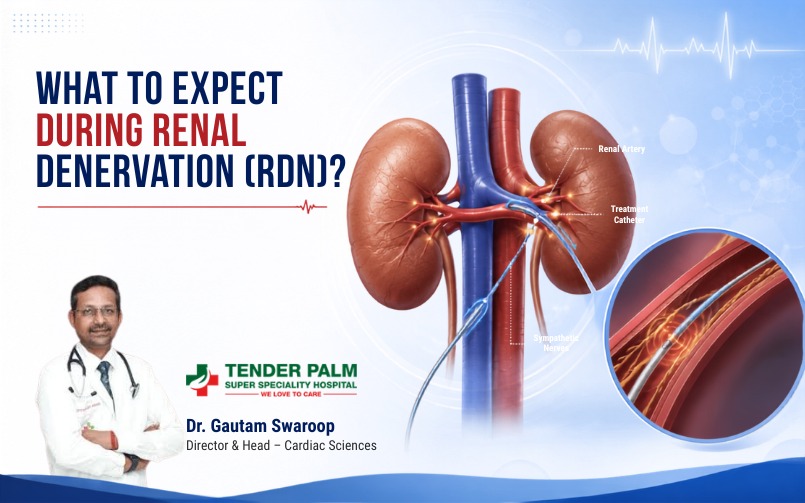
Renal denervation is a catheter-based procedure that targets the nerves around the renal arteries, which are the blood vessels that supply the kidneys. These nerves are part of the body’s sympathetic nervous system, which can influence blood pressure regulation. In some patients, overactive nerve signals may contribute to persistent hypertension. RDN aims to reduce these nerve signals by delivering energy through a catheter placed in the femoral artery, usually through a small access point in the groin.
Modern RDN systems use either ultrasound energy or radiofrequency energy to affect the nerves around the renal arteries. The goal is not to remove the kidneys or block blood flow to them. The goal is to interrupt the nerve activity that may be helping maintain high blood pressure. That distinction matters, because many patients hear the term “denervation” and assume something drastic or destructive is happening. In reality, the procedure is designed to be targeted and controlled.
It is also important to understand that RDN does not mean a person can stop their medicines or ignore follow-up care. It is an additional treatment option for selected patients. The procedure may help reduce blood pressure, but long-term management of hypertension still depends on a combination of treatment, monitoring, and healthy habits.
Why Patient Selection Matters
This is the most important part of the entire discussion. RDN is not intended for every person who has high blood pressure. It is meant for patients with resistant hypertension or persistently uncontrolled hypertension despite proper lifestyle measures and antihypertensive therapy. That means the patient must first be evaluated carefully to confirm that the blood pressure problem is genuine, ongoing, and not explained by another cause.
A major reason patient selection matters is that not all high blood pressure is the same. Some patients have primary hypertension, which is the common form seen in most adults. Others have secondary hypertension, where another underlying condition is driving the blood pressure higher. If that underlying cause is not identified, the wrong treatment may be chosen. In that situation, RDN may not help much because the real problem is somewhere else.
Good selection also means checking whether the patient has actually taken medicines correctly, whether doses were adjusted appropriately, whether side effects limited treatment, and whether blood pressure readings were confirmed outside the clinic. A patient may appear uncontrolled in the office but not truly be uncontrolled at home. Another patient may not be taking medicines regularly. These differences matter a lot.
This is why specialists do not jump directly to procedures. They first ask practical questions: Is the blood pressure truly high? Is the treatment optimized? Is there a reversible cause? Is the patient a realistic candidate?. Only after these questions are answered should RDN be discussed seriously.
Who May Be an Ideal Candidate?
A patient may be considered a stronger candidate for RDN when blood pressure remains high despite proper lifestyle changes and medications, and when the overall clinical picture suggests that an additional intervention may help. In modern practice, this often includes patients with resistant hypertension or stubbornly uncontrolled hypertension, especially when medications cannot be increased further because of side effects or tolerability issues.
The ideal candidate is usually someone who has already made a genuine attempt at management. That means:
- blood pressure has stayed high over time,
- the patient has tried dietary changes, exercise, salt reduction, and other lifestyle improvements,
- prescribed medicines have been taken properly,
- the treatment plan has already been reviewed carefully,
- and the patient understands that RDN is an adjunctive treatment, not a cure.
This is an important reality check. A strong candidate is not someone hoping for a miracle. It is someone who has a clear medical reason for needing another option. In some patients, RDN becomes attractive because control is still poor despite genuine effort. In others, the patient may have side effects from medicines that limit further dose escalation. In such cases, RDN may play a role as part of a broader blood pressure strategy.
The right candidate also needs to be willing to continue follow-up. That point is often underestimated. RDN is not a one-time fix that ends the story. Blood pressure must still be monitored, treatment still must be reviewed, and long-term cardiovascular risk still needs management.
Who May Not Be a Suitable Candidate?
RDN is not the right choice for everyone. Patients with secondary hypertension should be identified and treated for the underlying cause first. Secondary causes may include kidney disease, narrowing or problems with the renal arteries, endocrine disorders, or blood pressure raised by certain medications or substances. If one of these causes is present, treating the cause may be more important than performing RDN.
A patient may also be a poor candidate if the blood pressure has not been properly evaluated. For example, if office readings are high but home readings are not, the patient may not truly have persistent uncontrolled hypertension. Likewise, if medicines have not been tried correctly or have not been optimized, it would be premature to consider an intervention.
Poor adherence is another problem. If a patient is not taking prescribed medicines regularly, the issue is not that treatment has failed. The issue is that treatment has not been fully used. RDN should not be used as a shortcut around poor adherence.
Another reason a person may not be a suitable candidate is unrealistic expectation. Some patients hope that RDN will permanently cure hypertension and allow them to stop all treatment. That belief is not correct. High blood pressure usually still needs long-term management. RDN may help some patients, but it does not erase the need for ongoing medical care in most cases.
Tests and Evaluation Before RDN
Before RDN is considered, doctors usually review the full blood pressure history, current medicines, lifestyle habits, and other medical conditions. The goal is to confirm that hypertension is truly uncontrolled and not being driven by something else that can be corrected. This step is where good medicine happens. Skipping it would be careless.
A proper evaluation often includes clinic blood pressure readings, home blood pressure data, or ambulatory blood pressure monitoring. This helps determine whether the patient has true persistent hypertension or whether the readings are misleading. The doctor also reviews all current medicines, including dosage, timing, missed doses, and any side effects.
Kidney function and general health are also checked. This matters because the kidneys are central to the whole discussion and because the patient must be fit for a catheter-based procedure. Doctors also look for secondary causes of hypertension when needed. Depending on the patient, this may involve additional blood tests, imaging, or consultation with other specialists.
This evaluation is not just about eligibility. It is also about safety. A procedure should only be done when the potential benefit is meaningful and the risk is acceptable. That is why expert review is important and why RDN is never a casual decision.
Step-by-Step RDN Procedure
Here is what the procedure usually looks like in simple patient-friendly language.
Step 1: Preparation
The patient is admitted and prepared for the procedure. The medical team reviews the history, medicines, blood pressure status, and relevant test results. The patient may be asked to follow fasting instructions or adjust certain medicines as advised by the hospital.
Step 2: Anesthesia and comfort
RDN is usually performed with local anesthesia and appropriate sedation so the patient remains comfortable. This is not open surgery. The goal is to make the procedure safe, tolerable, and controlled.
Step 3: Catheter insertion
A small puncture or incision is made in the groin area, and a catheter is advanced through the femoral artery toward the renal arteries. This access route is standard for catheter-based procedures. The team uses imaging and careful technique to position the catheter correctly.
Step 4: Treatment delivery
Once the catheter reaches the renal artery area, the device delivers ultrasound or radiofrequency energy around the artery. This affects the nerves surrounding the vessel. The aim is to reduce the nerve-driven signals that may contribute to persistent high blood pressure.
Step 5: Completion and observation
After treatment is completed, the catheter is removed and the access site is cared for. The patient is then observed for a period of monitoring to ensure stability, comfort, and recovery.
The procedure is technical, but for the patient, it usually feels like a controlled hospital intervention rather than a major operation. That is one of the reasons it is often called minimally invasive.
What to Expect on the Day of the Procedure
On the day of the procedure, patients are usually asked to arrive early and bring all relevant medical records, test reports, and medication details. Following the hospital’s instructions carefully is important. If fasting is required, the patient should follow that instruction exactly. If certain medicines need to be taken or withheld, that should be done only as advised by the doctor.
Most patients remain awake enough to understand what is happening, although sedation helps with comfort. Monitoring is continuous before, during, and after the procedure. Blood pressure, heart rhythm, and general status are watched closely. This is a controlled medical setting, not something that is done casually.
Patients should also expect to stay under observation for some time after the procedure. The medical team may check the access site, review symptoms, and confirm that recovery is going as expected before discharge. The experience is much less intense than open surgery, but it still deserves proper aftercare and follow-up.
Recovery After Renal Denervation
Recovery after RDN is usually shorter and easier than recovery after major surgery. Most patients need a period of observation, and then they are discharged with instructions about rest, wound care, activity limits, and follow-up appointments. The groin access site may need a little time to heal, and the patient may be advised to avoid heavy exertion for a short period.
One very important point is that medicine changes are decided by the doctor, not by the procedure alone. Many patients continue antihypertensive treatment, at least initially, while blood pressure is monitored over time. That is completely normal. It would be a mistake to assume that the procedure automatically means medicines can be stopped.
Follow-up is essential because blood pressure control is not judged by one moment after the procedure. It is assessed over days, weeks, and months. Doctors may monitor home blood pressure readings, review symptoms, and adjust the treatment plan gradually if needed.
Lifestyle changes also remain central. Healthy eating, regular physical activity, weight management, reduced sodium intake, smoking cessation if relevant, and proper sleep all continue to matter. RDN may add value, but it does not replace the basics. Patients who ignore lifestyle management after the procedure are missing a major part of hypertension care.
Benefits and Limitations
The main benefit of RDN is that it offers an additional treatment option for selected patients whose blood pressure remains uncontrolled despite standard care. For the right patient, that can be meaningful. In some cases, it may help improve blood pressure control when medicines and lifestyle changes alone have not been enough.
The limitation is just as important. RDN is not a magic cure. It does not eliminate the need for long-term care. It does not automatically mean the patient can stop medicines. It does not guarantee normal blood pressure forever. It is best viewed as one more tool in the treatment of hypertension, not the end of treatment.
That honest view is better than selling false hope. Patients deserve clarity. If RDN is appropriate, it should be used for the right reasons. If it is not appropriate, then saying so is part of good care too. The most valuable thing a doctor can do is help the patient choose wisely, not simply choose quickly.
Myths vs Medical Facts
| Myth | Medical Fact |
|---|---|
| RDN is for every patient with high blood pressure. | RDN is only for carefully selected patients with uncontrolled or resistant hypertension after proper evaluation. |
| RDN permanently cures hypertension. | RDN may help lower blood pressure, but it is not a cure and does not replace ongoing care. |
| Medicines can always be stopped after the procedure. | Medicines are often continued, and any change must be made by the treating doctor. |
| Recovery is long and painful. | RDN is a minimally invasive catheter procedure, so recovery is usually much simpler than open surgery. |
| Patient selection is not important. | Patient selection is the most important step because the wrong candidate may not benefit meaningfully. |
When to Speak to a Cardiologist
A cardiologist should be consulted if blood pressure remains high despite medicines, if medications cause side effects, if clinic readings and home readings differ significantly, or if there is any suspicion of secondary hypertension. These are not situations to handle by guessing or self-research alone.
Patients should not decide on RDN based on social media clips, hearsay, or incomplete online posts. A proper medical assessment is needed first. That assessment may reveal that the patient is not a candidate, or it may confirm that RDN is worth considering. Either way, the decision should be based on evidence, not excitement.
Frequently Asked Questions
- 1. Who is the best candidate for RDN?
- Usually a patient with persistent uncontrolled blood pressure despite good lifestyle changes and appropriate medical therapy, after secondary causes have been excluded.
- 2. Is the procedure painful?
- RDN is performed as a catheter-based procedure with anesthesia and monitoring, so it is generally not described as major surgery.
- 3. Will I need to continue medicines?
- Often, yes. RDN is an adjunctive treatment, and medicine decisions are made by the doctor based on follow-up blood pressure readings.
- 4. How long does recovery take?
- Recovery is usually relatively short compared with surgery, but follow-up is still essential because blood pressure needs ongoing monitoring.
- 5. Is RDN suitable for everyone with uncontrolled blood pressure?
- No. It is only for selected patients after careful evaluation, not for every person with high blood pressure.
Conclusion
Renal denervation is an important option, but only for the right patient. That is the main message. The outcome depends not just on the procedure itself, but on selecting the right candidate, confirming the diagnosis properly, and being honest about what the treatment can and cannot do.
For patients with uncontrolled blood pressure, the next step should not be guessing or hoping. It should be a detailed assessment with a cardiologist who can decide whether RDN is appropriate. When patient selection is done well, the procedure has a real role. When it is done carelessly, even the best procedure can disappoint.
About Dr. Gautam Swaroop
Dr. Gautam Swaroop is an experienced interventional cardiologist who provides evidence-based cardiovascular care and patient education. His approach focuses on choosing the right treatment for the right patient after proper clinical evaluation.
This article is for educational purposes only and should not be used as a substitute for professional medical advice, diagnosis, or treatment. Patients should always consult a qualified cardiologist or physician for individual recommendations.

You must be logged in to post a comment.