A Milestone in Cardiac Care: Successful TAVI and Complex Angioplasty in a High-Risk 78-Year-Old Patient
Quick Summary
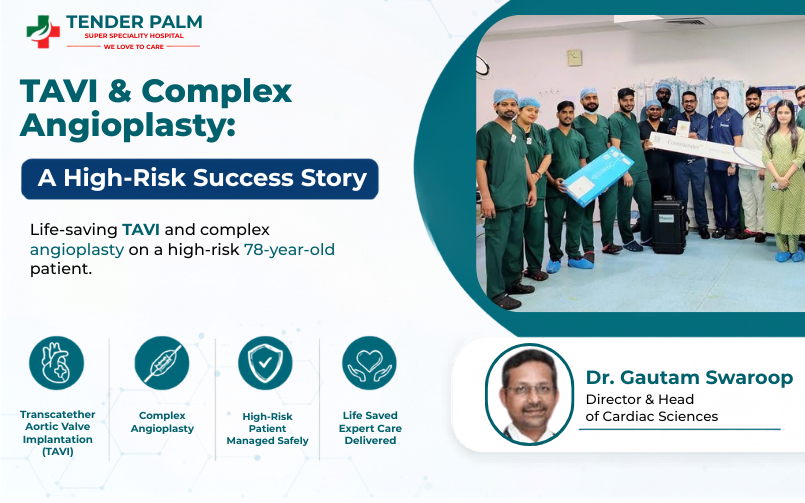
A recent media feature highlighted a landmark cardiac procedure at Tender Palm Hospital. Specifically, our team successfully completed two simultaneous interventions on a high-risk 78-year-old patient. These included Transcatheter Aortic Valve Implantation (TAVI) and complex angioplasty. Consequently, this success story underscores a vital truth in modern cardiology. Namely, advanced age and complex heart disease no longer mean a lack of options. Furthermore, with timely intervention, teamwork, and cutting-edge technology, life-saving outcomes are entirely possible.
Introduction: Facing a Dual Cardiac Threat
Treating elderly patients with multiple severe heart conditions requires immense precision. Recently, we faced a formidable clinical challenge in a 78-year-old patient. This patient suffered from severe aortic stenosis, which is a dangerously narrowed heart valve. Additionally, they had critical coronary artery disease. This meant heavily blocked arteries severely restricted blood supply to the heart.
Historically, medical guidelines consider a patient of this age with a dual diagnosis extremely high-risk for open-heart surgery. Furthermore, opening the chest cavity causes significant trauma and requires a prolonged recovery. Therefore, this risk often deters both families and physicians from pursuing traditional surgery. However, leaving the condition untreated was simply not an option. Because symptomatic severe aortic stenosis carries a high mortality rate, we needed an immediate solution. Ultimately, our team at Tender Palm Hospital utilized state-of-the-art, minimally invasive interventions to address both issues simultaneously.
Table of Contents
- The Clinical Challenge: Why Was This High-Risk?
- Understanding the Procedures: TAVI and Complex Angioplasty
- The Tender Palm Hospital Approach: Teamwork & Precision
- Why Timely Intervention Matters
- Frequently Asked Questions (FAQs)
- Conclusion
The Clinical Challenge: Why Was This High-Risk?
Age alone does not disqualify a patient from heart procedures. Instead, it changes the physiological landscape. For example, our 78-year-old patient exhibited significant frailty and multiple comorbidities. Consequently, traditional Coronary Artery Bypass Grafting (CABG) and surgical valve replacement became exceptionally dangerous.
- The Valve Issue: Severe aortic stenosis forces the heart to work exponentially harder. Specifically, it struggles to pump blood through a calcified, stiff valve. As a result, this leads to shortness of breath, chest pain, and heart failure.
- The Artery Issue: Meanwhile, the patient had heavily calcified, complex blockages in their coronary arteries. Consequently, these blockages deprived the straining heart muscle of much-needed oxygen.
Understanding the Procedures: TAVI and Complex Angioplasty
To safely resolve both issues without opening the chest, we utilized two advanced catheter-based techniques. Importantly, both methods are minimally invasive.
1. Complex Angioplasty
First, we had to ensure the heart muscle received adequate blood supply before fixing the valve. Therefore, we used specialized imaging to carefully navigate catheters to the blocked coronary arteries. Next, we deployed advanced stents to crush the calcified plaques and prop the arteries open. Consequently, this complex angioplasty immediately restored healthy blood flow to the heart muscle.
2. Transcatheter Aortic Valve Implantation (TAVI)
Doctors also call this TAVR (Transcatheter Aortic Valve Replacement). Essentially, this revolutionary procedure allows us to replace a failing heart valve without removing the old one. First, we guided a fully collapsible replacement valve through a small puncture in the groin. Next, we accurately positioned the new device inside the diseased valve. Finally, we expanded the new valve, and it immediately took over regulating blood flow.
The Tender Palm Hospital Approach: Teamwork & Precision
As the media recently highlighted, a single doctor did not achieve this success alone. Instead, a coordinated symphony of medical professionals made it possible.
At Tender Palm Hospital, our focus remains strictly on delivering evidence-based, patient-centered cardiac treatment. For this specific case, our multidisciplinary Heart Team meticulously planned every step of the intervention. This team included interventional cardiologists, cardiac surgeons, cardiac anesthetists, and specialized nursing staff. Ultimately, this collaboration ensured our team anticipated and mitigated every potential complication. As a result, this high-risk 78-year-old patient recovered rapidly and returned to a high quality of life.
Why Timely Intervention Matters
Above all, this case serves as a powerful reminder to the community. Namely, you must never ignore the warning signs of heart disease, regardless of your age.
For instance, symptoms like unexplained fatigue, shortness of breath, dizziness, or chest tightness are serious. They are not simply “normal signs of aging.” Rather, they are distress signals from your heart. Furthermore, when severe aortic stenosis begins causing symptoms, the survival rate drops drastically without treatment. Therefore, timely intervention is the crucial factor. It transforms a life-threatening crisis into a highly successful medical procedure.
Frequently Asked Questions (FAQs)
Is TAVI safe for elderly patients?
Yes. In fact, medical experts developed TAVI specifically for elderly and high-risk patients with severe aortic stenosis. Overall, it provides a safer, less invasive alternative to open-heart surgery.
Can doctors perform angioplasty and TAVI at the same time?
Yes. Depending on the patient’s anatomy and stability, our specialized cardiac team can safely perform TAVI and complex angioplasty during the same admission. Ultimately, this approach minimizes the patient’s hospital stay and recovery time.
How long does it take to recover from a TAVI procedure?
Because TAVI is minimally invasive and does not involve cutting the chest bone, recovery is significantly faster. For example, most patients are up and walking within a day. Furthermore, they can usually return home within a few days.
Conclusion
In conclusion, the successful outcome for this 78-year-old patient stands as a testament to interventional cardiology. Indeed, advanced age should never be a barrier to breathing easier, living actively, and enjoying family time. At Tender Palm Hospital, we remain committed to pushing the boundaries of cardiac care. We achieve this with compassion, precision, and state-of-the-art technology.
Book your Appointment now
Have you or an elderly loved one been diagnosed with severe valve disease or complex coronary blockages? If so, you deserve a second opinion from a dedicated Heart Team. Therefore, contact Dr. Gautam Swaroop at Tender Palm Hospital today. Together, we can explore advanced, minimally invasive treatment options tailored to your specific needs.
Medical Disclaimer: Please note, the information provided in this article is for educational purposes only. It does not substitute for professional medical advice. Furthermore, individual patient risks and treatment outcomes vary. Always consult a qualified cardiologist to determine the best treatment plan for your specific condition.

You must be logged in to post a comment.